

SEO Traffic is organic traffic from search engines. When someone types a query into Google, looks through the search results, and clicks through to your website ⎯ organic, free, natural traffic from search engines.
In this guide, you’ll learn why SEO traffic is important and the 5 best practices to improve your search engine rankings and drive more traffic from Google.
Content List
- How to see organic traffic in Google Analytics
- Organic traffic contributes to the path to purchase
- Organic traffic is targeted with a specific search intent
- 5 effective ways to increase your SEO traffic
- 1. Target the right keywords for SEO
- 2. Create high-quality content that matches search intent
- 3. On-Page SEO Optimization
- 4. Publish new blog posts regularly to increase SEO traffic
- 5.Increase domain authority and rank higher on SERPs
How to see organic traffic in Google Analytics
In Google Analytics (Universal Analytics), you can find organic traffic in the Organic Search channel.
Acquisition > All Traffic > Channels
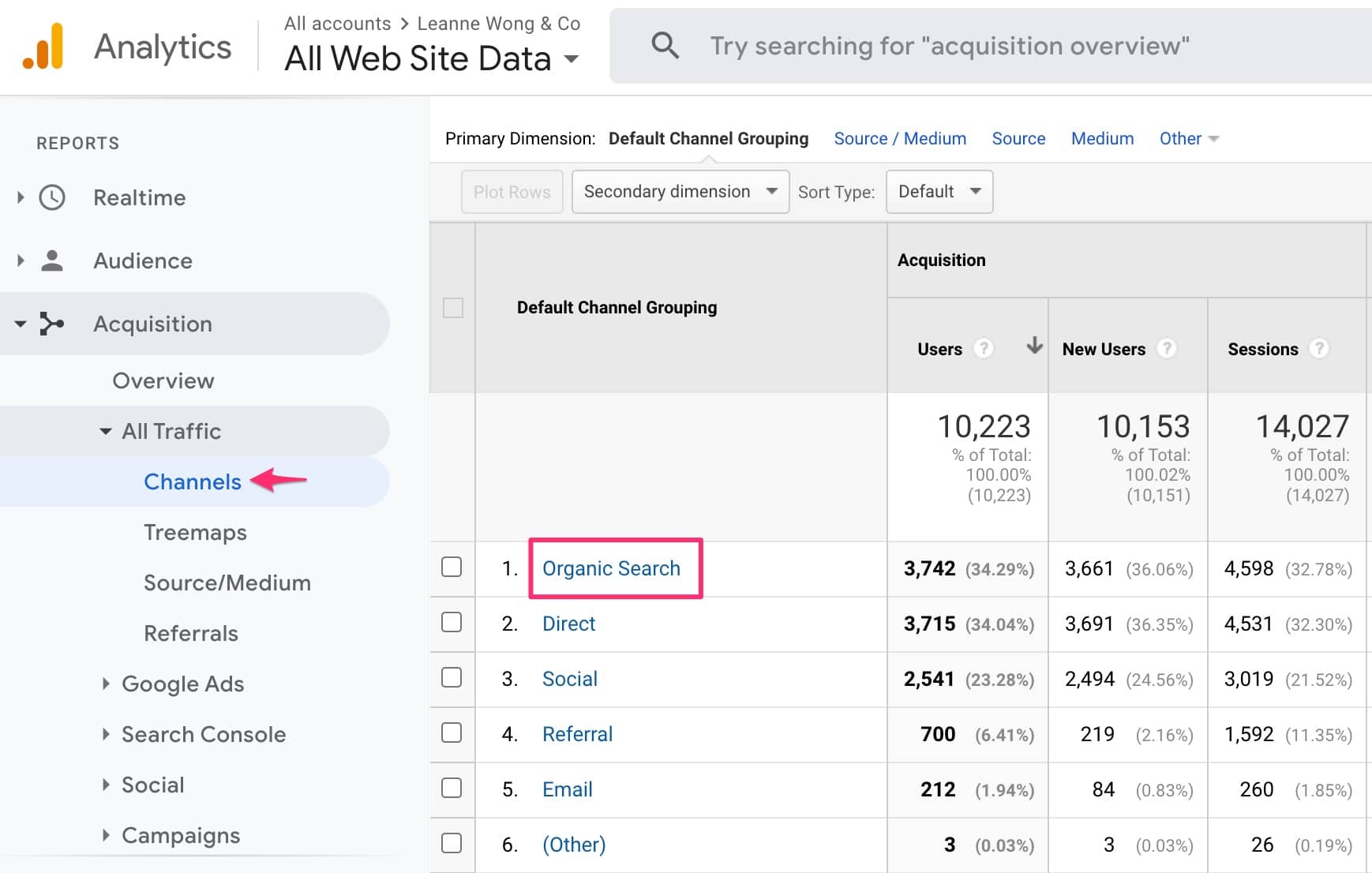
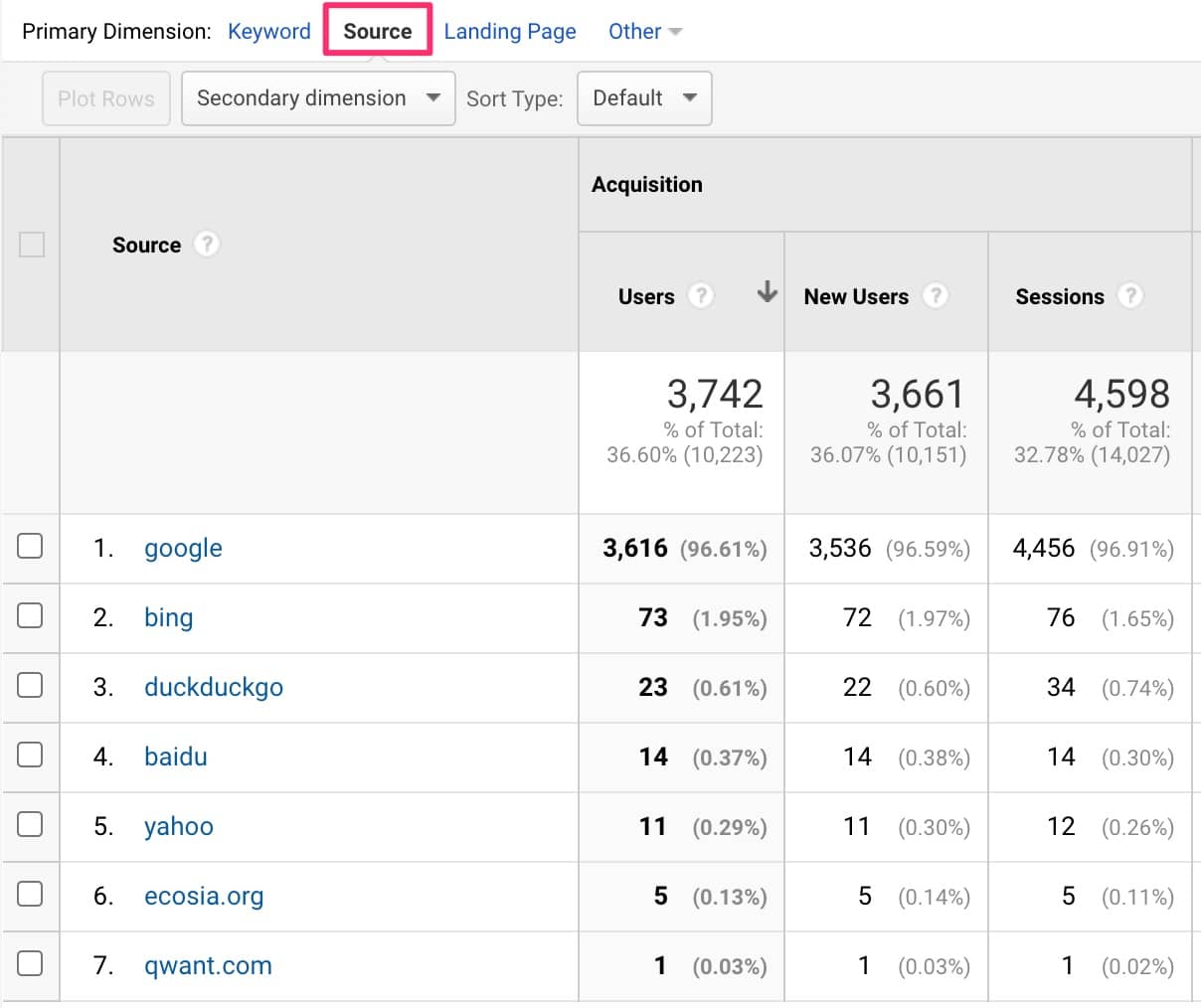
Click on the Organic Search channel, then select the Source dimension and you’ll see the different types of search engines that are driving traffic to your site.
Google will be the top source of organic search traffic because it is the largest search engine. So search engine traffic is essentially traffic from Google.
Google leads with an 83% share of the global search market, followed by 9% for Bing and Yahoo comes in third at 2.55%. So that makes Google the largest search engine worldwide and that is where most search traffic will come from.
So Search Engine Optimization (SEO) is about optimizing our website to rank on Google’s search engine results pages (SERPs) to drive traffic.
Why are SEO and organic traffic important?
SEO traffic is important because it increases your visibility online. There are over 3.5 billion search queries made on Google every day. That is a huge pool of search traffic you can tap into.
A good SEO strategy helps your website rank high on SERPs when your audience searches for you. This leads to new visitors to your website filling up your sales funnel.
Organic traffic contributes to the path to purchase
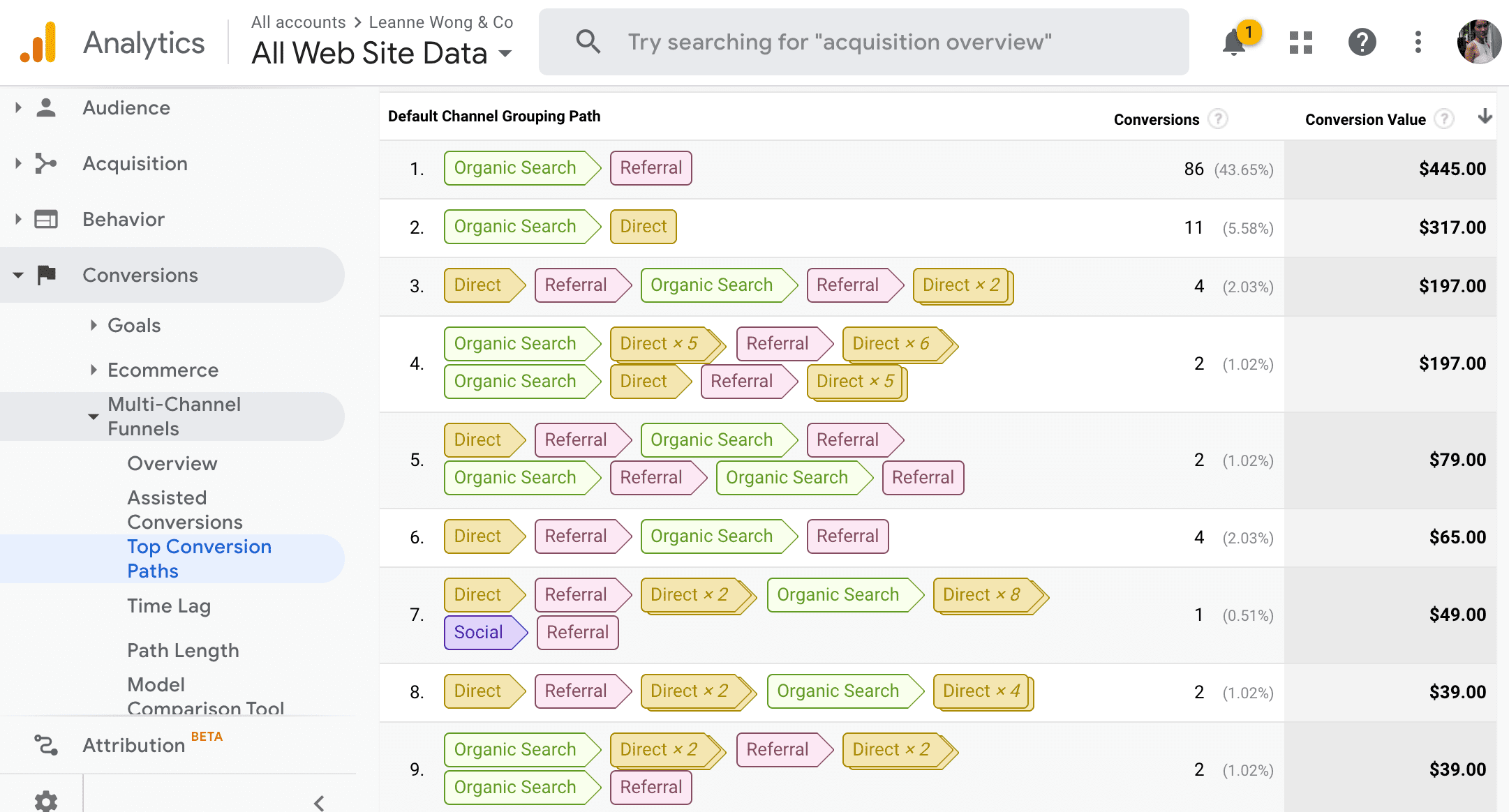
Organic search can play a major role in how you drive conversions. Users are searching for you on Google multiple times before making the decision to purchase. You want a strong SEO strategy to rank on the top 10 positions in organic results when your audience searches for you.
Organic traffic is targeted with a specific search intent
People who find you from a search engine result page have a specific intent and are intentionally looking for a solution. They tend to be qualified traffic and are more ready to take action on your site.
So it’s important to rank for important keywords that your customer avatar would search for. These are sometimes called money keywords.
For me, these would be my service-related keywords. Such as SEO coaching, SEO coach.
One of my coaching clients had actually found me this way. This was a person who didn’t know who I was until he found my site through Google. He searched for one on one seo and content marketing coach, found my page, and got on a discovery call with me. Just like that!
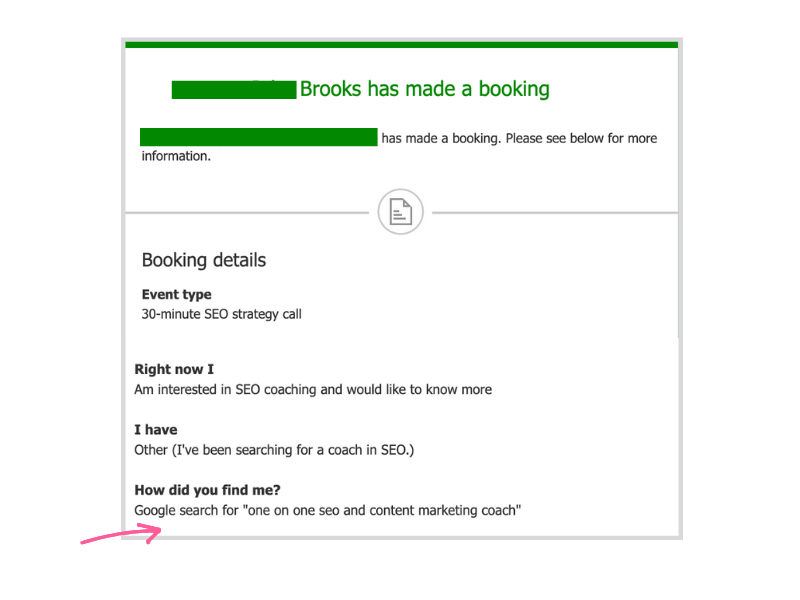
If you have the right content that can answer the user’s query, this can lead to conversions in one session.
How to increase your SEO traffic
To increase organic traffic from search engines, you need to rank for keywords that people are actively searching for. This looks into keyword search volume and keyword difficulty.
Your website’s ranking position affects the amount of traffic you can generate from search engines. Pages ranking on the first 3 positions on Google typically receive the most click-throughs and traffic.
1. Target the right keywords for SEO
The right keywords should be relevant to your business. So these are keywords that your potential customers may search for.
A great way to do keyword research is with Google.
I recommend using an inexpensive keyword research tool like Keywords Everywhere to help you find keyword ideas and get important keyword metrics.
Start your research with a broad term that your target audience would search for. Then study the Google autocomplete suggestions for long-tail keywords. These are predictions from trends and the user’s personal search history.
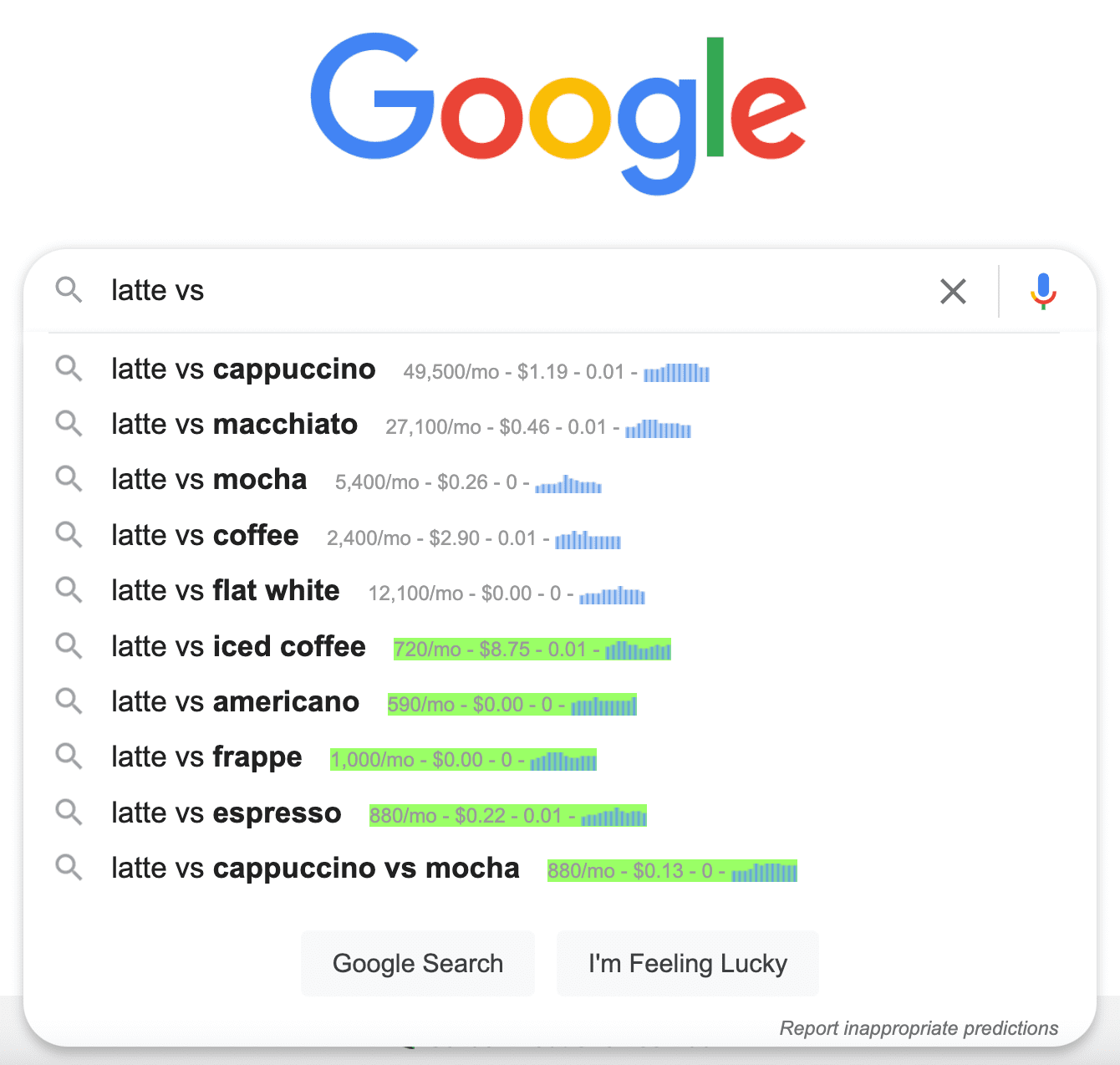
Search volume
To drive SEO traffic, you’ll want to rank for keywords with sufficient search volume. Search volume is the number of searches for a keyword in a given timeframe. Keyword search volume is usually calculated over an average of 12 months.
In the above example, I’m using Keywords Everywhere which pulls the search volume data from Google Keyword Planner. This is the most accurate source of keyword search volume data because it comes directly from Google.
I’d recommend using Keywords Everywhere to find the search volume and search trends data so you can assess the traffic potential of keywords you want to rank for.
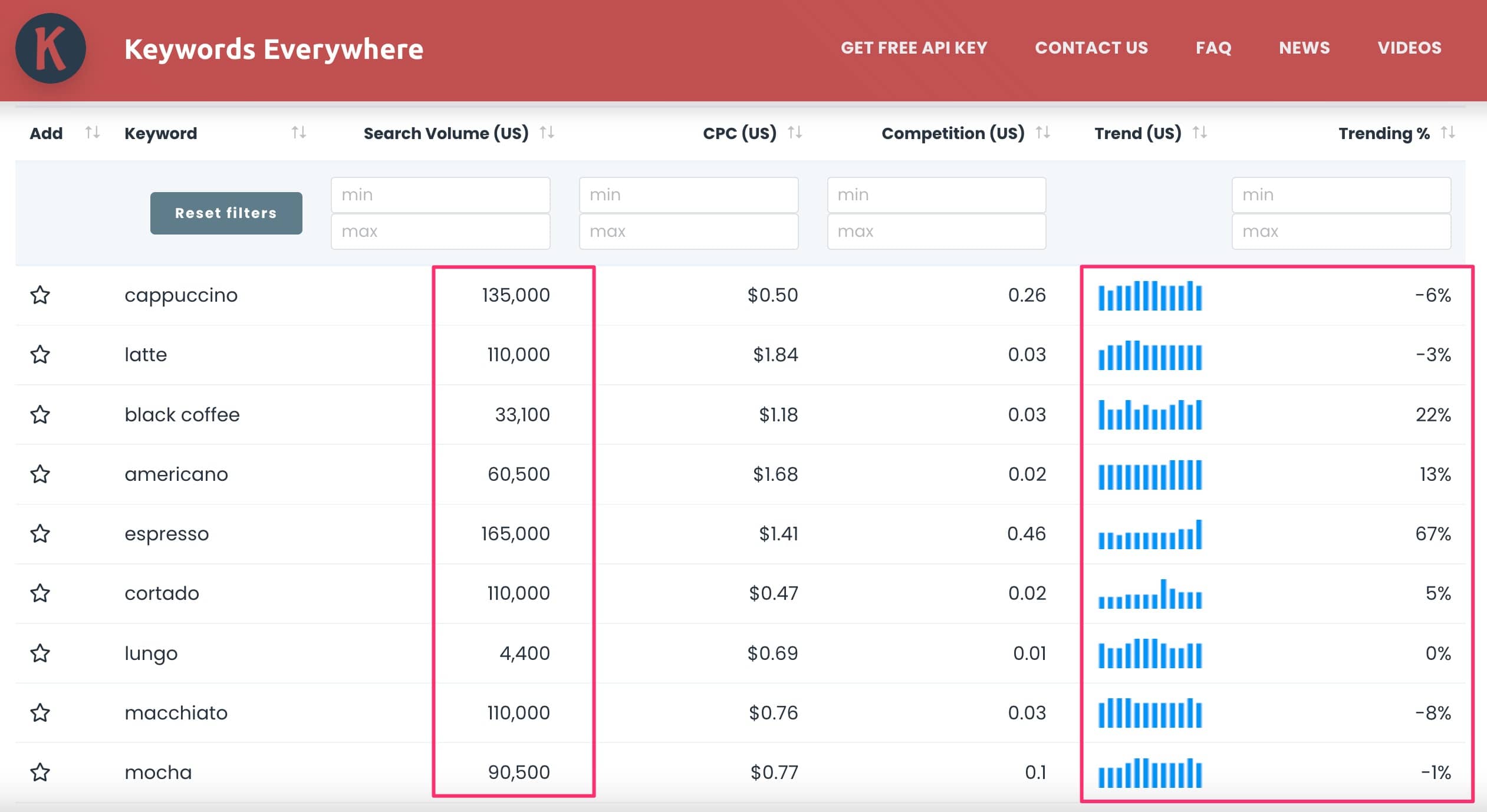
Search volume is an important metric in your SEO traffic strategy. You can use this data to prioritize keywords with a higher search volume and attract more visits to your site.
The higher the keyword search volume, the more traffic you could generate from ranking for it.
I have been coaching students on how to look at keyword data in their SEO strategy and this is often an easy fix that can increase traffic very quickly.
Sometimes changing the keyword focus from a low search volume keyword to one with a higher search volume can squeeze more traffic from an existing article. If you find that your blog post content is ranking well on Google but not driving much traffic, try changing the keyword focus to one with higher searches.
Keyword difficulty
Keyword difficulty (also known as “SEO difficulty”) is a measure of how difficult it would be to rank in Google’s organic search results for a specific keyword query. A keyword’s difficulty is calculated based on different factors such as content quality, on-page factors, domain authority, and page authority.
This is a useful metric to assess whether it would be easy to rank on the first page for a given keyword.
The higher your search engine rankings, the more traffic you can generate from search engines. So you want to avoid targeting keywords that are too difficult to rank for.
I like using Ahrefs and their keyword explorer tool to check keyword difficulty. The KD score is based on off-page SEO factors and the number of backlinks to rank for a keyword.
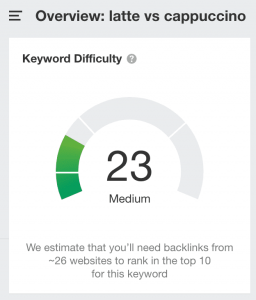
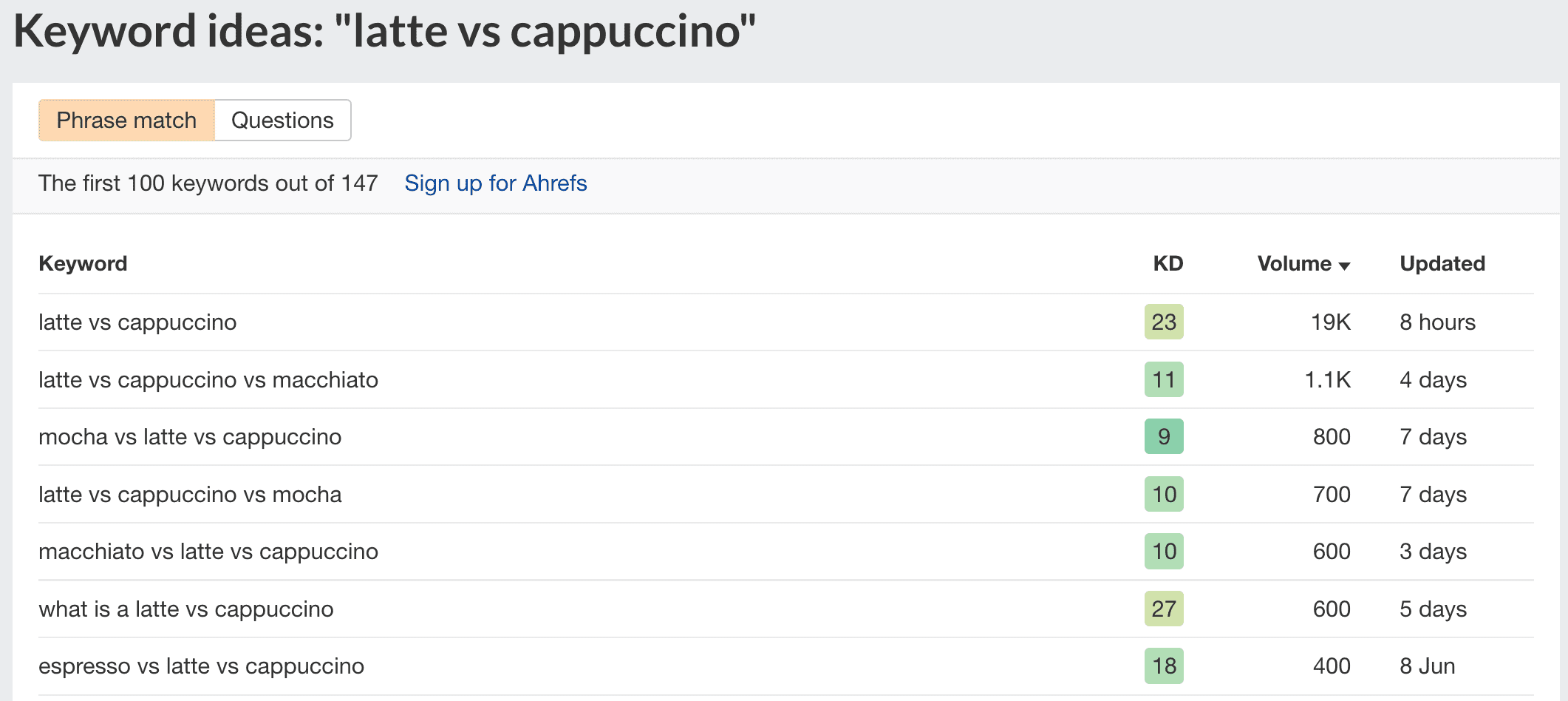
Ahrefs also has a free keyword generator tool that provides the first 100 keyword ideas based on your input keyword.
It also shows the Keyword Difficulty score of the first 10 keywords. This is a really nice free tool to quickly check keyword difficulty metrics!
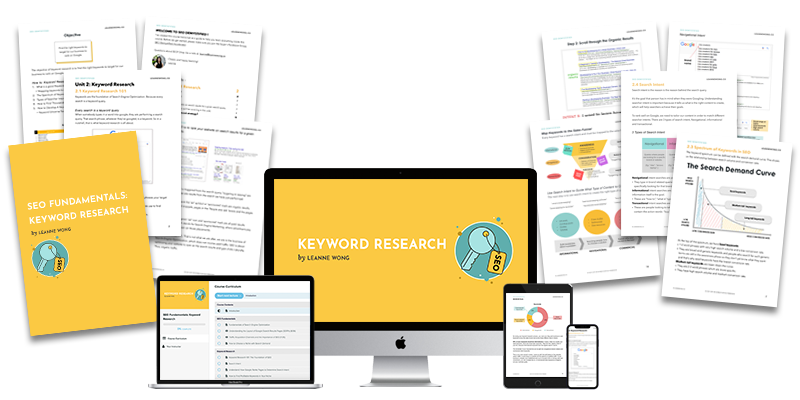
SEO Fundamentals: Keyword Research Course
In my SEO Fundamentals: Keyword Research Course, I share strategies on how to pick the best keywords with high traffic potential and low ranking difficulty. You’ll learn what is the ideal search volume to look out for, and how to analyze keyword difficulty and target keywords in your content to drive SEO traffic.
At only $39, this course will be the most pocket-friendly investment you’ll make to learn how to do SEO keyword research the right way.
2. Create high-quality content that matches search intent
After picking the right keywords, we would need to create high-quality content that matches the user’s search intent.
Let’s talk about content quality first. The first step is to create useful content that is beneficial for the reader.
Content quality
I think Google’s checklist of content and quality questions covers the criteria of useful content:
- Does the content provide a complete and sufficient description of the page topic?
- Does the content provide insightful information that is helpful?
- Does the content have original research or information?
- Is the content written by people with expertise on the subject matter?
- For YMYL topics (Your Money Your Life: eg, legal, finance, medical), does the person have accreditation/formal education/training
- Does the content have any spelling and grammar errors?
- Is the content easy to read and scannable?
Content topics that Google thinks are important to rank on the first page for your target keyword
There is one aspect of content optimization that I have found to be incredibly effective in increasing SEO traffic.
That is creating long-form content by covering topics that Google thinks are important. Previously, I was doing this manually (analyzing the top ranking articles and their headings and content outline) to see what specific topics and relevant keywords are necessary to include to rank for my target keyword.
This would take at least 1-2 days. Now, I found a content optimization tool that helps me spend less time analyzing, and focus my time and effort on actually writing quality content.
The tool that I rely on is RankIQ which helps me figure out the most important content topics and relevant keywords to include that can rank on the first page on organic results.
IT’S AMAZING.
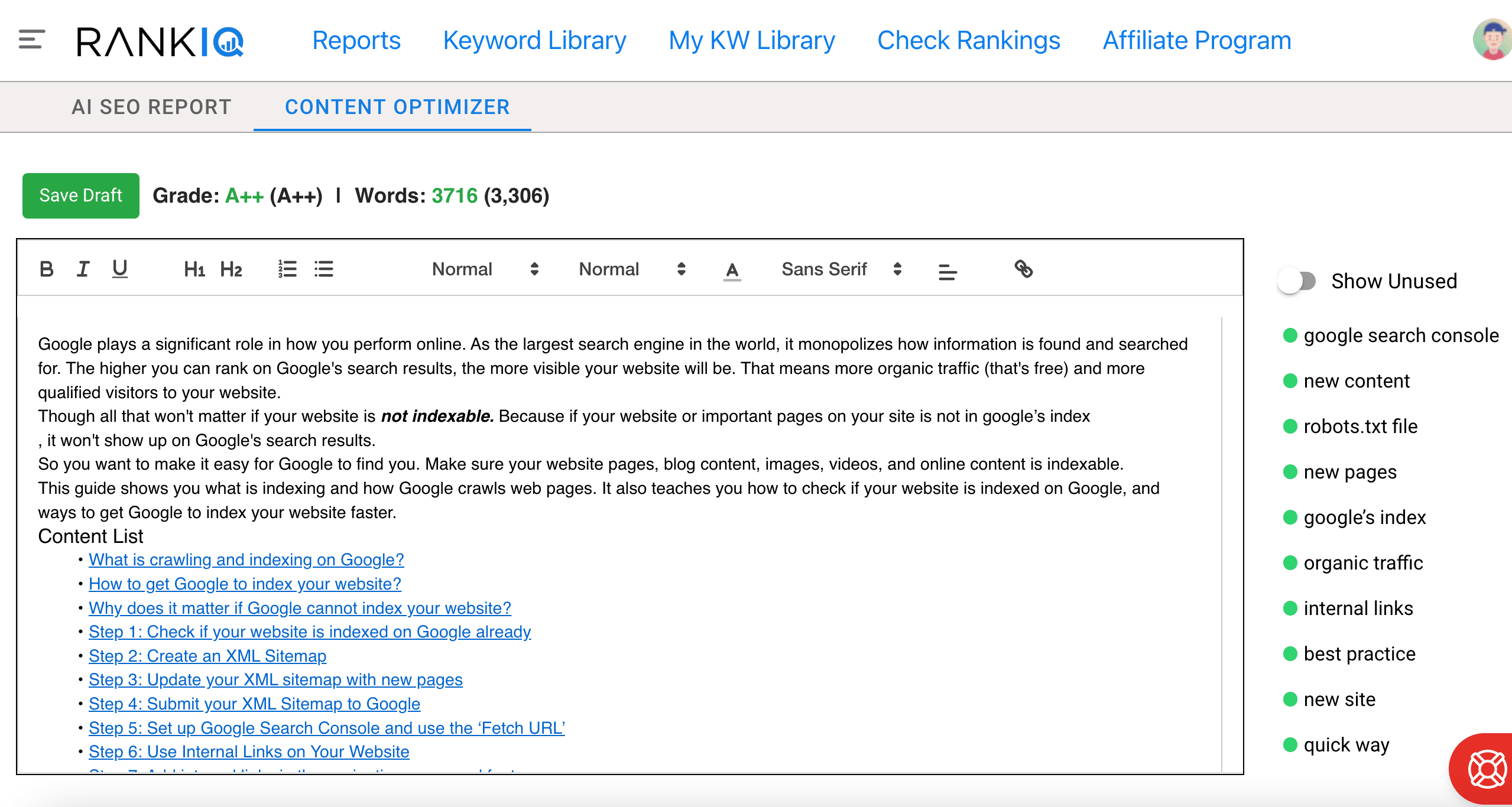
Since using RankIQ, I found it so much easier to write an SEO-optimized blog post as the tool suggests the most important topics to cover by analyzing the top 30 results ranking for your target keyword.
Search intent
Search intent is the purpose behind the search query. In other words, what is the user looking for when performing the Google search.
This is often about answering the user’s query. So put yourself into the shoes of the person searching:
- What would be the best answer to this query?
- What content and information would actually be useful and helpful?
There are three main types of search intent:

Understanding your target keywords’ intent will help you create the right content type and optimize your blog post/pages to answer their query and stand a better chance for rankings.
- For example, informational intent keywords would be “benefits of coffee”, “how to make coffee”. The user’s goal is to purely look for information. The best content type would be blog posts.
So creating a product page to rank for these informational intent keywords wouldn’t work.
- On the other hand, keywords like “buy coffee machine”, “best sofa with delivery” have a clear intention to take action. These are transaction / commercial intent keywords looking to purchase.
You would only target these keywords if you have an e-commerce store and products to sell.
- Navigational intent keywords are branded queries. These keywords contain a specific company’s brand name. Such as “coach logo“.
Generally, you want to avoid targeting another company’s branded keywords because their website pages would be ranking first.
It is usually difficult to outrank the company’s web pages and may be challenging to get users to click on your search result if they already have a particular brand in mind.
3. On-Page SEO Optimization
After picking keywords and creating great content that matches the user’s intent, the next step is to work on on-page SEO.
On-Page SEO optimization looks into keyword targeting and optimizing the HTML elements on the page. This makes your page content more relevant and useful to search engines and users.
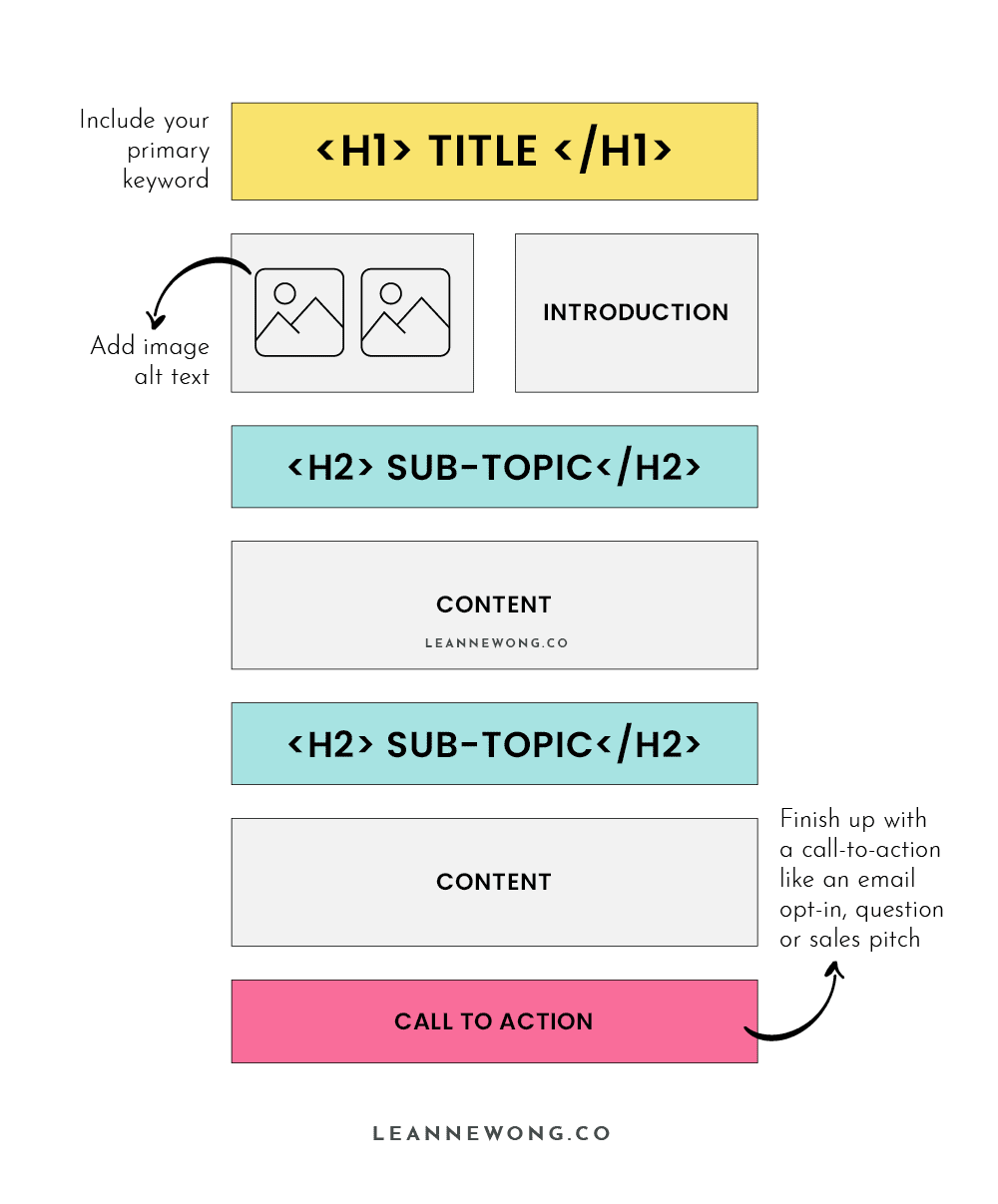
Improving on-page SEO is a high-impact activity that can boost search rankings for the keywords you are targeting and increase your SEO traffic.
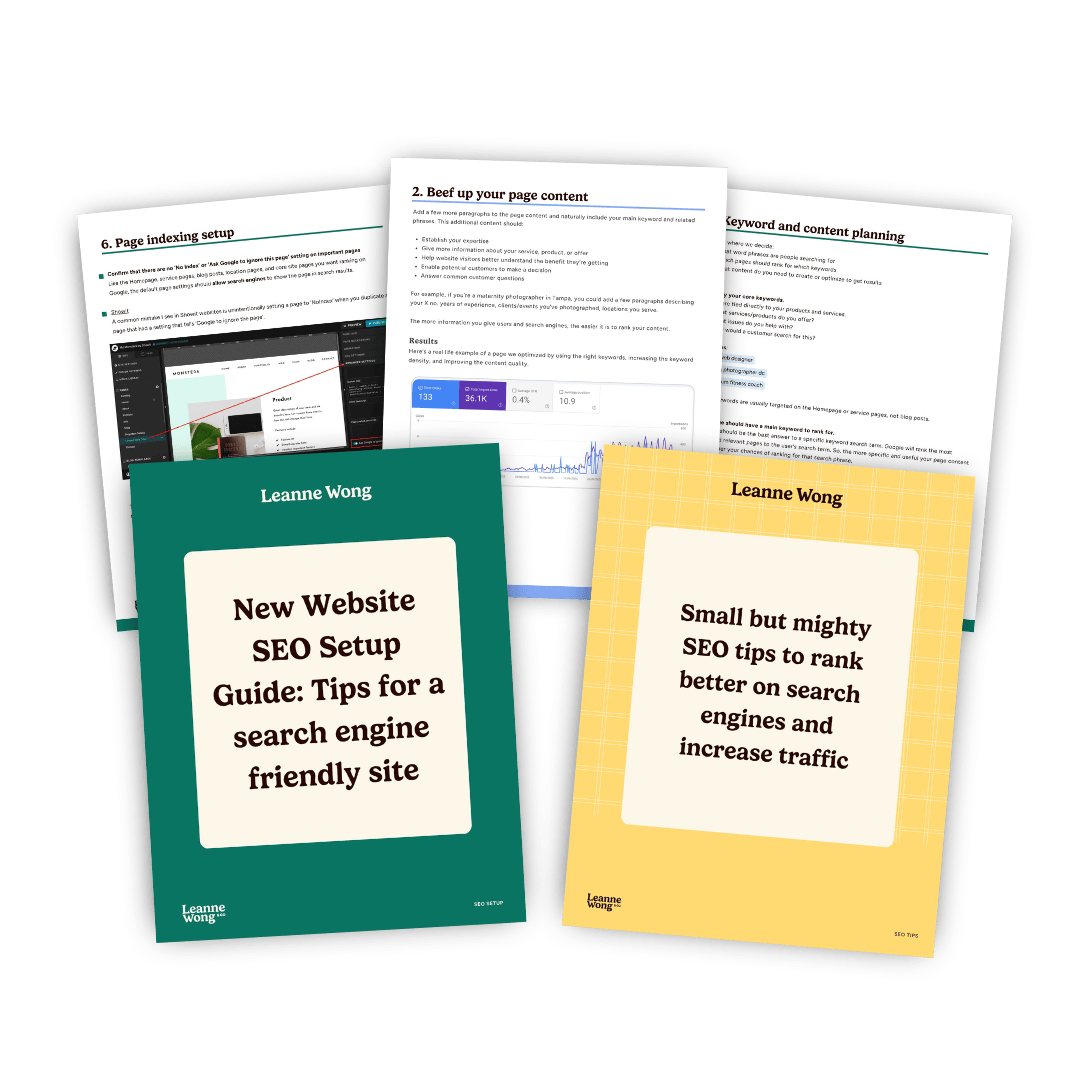
I have a free 94-Point SEO Audit Checklist that goes through the important on-page SEO factors such as:
- Page title
- Meta descriptions
- URL
- Heading tags
- Internal links
- External links
- Images
- Alt text
- Main content
and more!
>>> Here’s the link to download the free 94-point SEO Audit Checklist.
4. Publish new blog posts regularly to increase SEO traffic
Creating content to target keywords is how we can capture search traffic. So the more content you publish, the more keywords you can rank for and increase your website traffic.
I advise my coaching clients to publish at least one blog post and update one existing article per week.
We use a simple content hub planner like this to keep track of things:
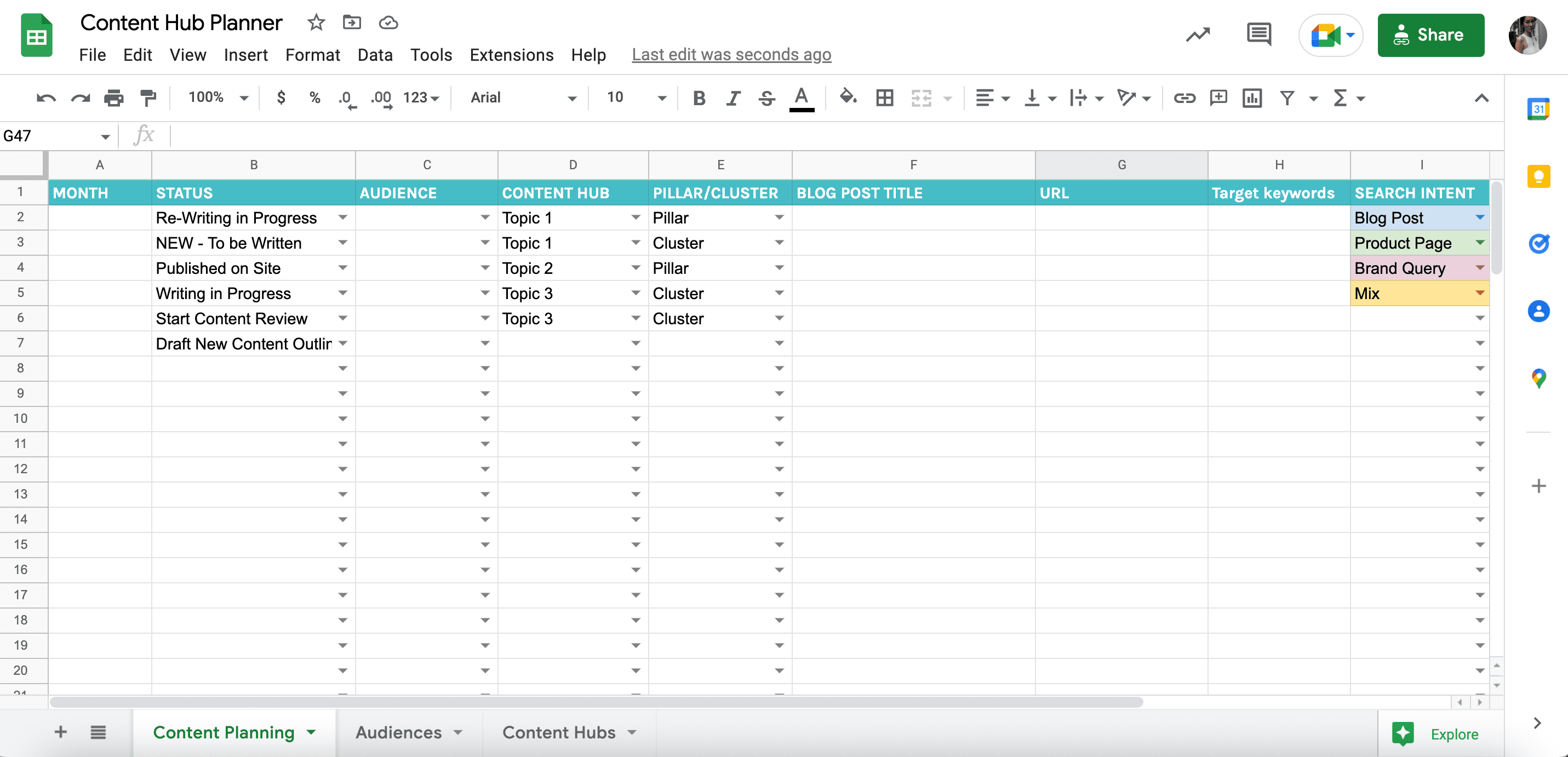
This helps keep our content fresh and updated with the most relevant information.
Also, the more you publish new content and keep your website updated, the more important your site will appear to search engines.
This increases the chances that Google will crawl your website more often and this gets your new pages and blog posts indexed faster.
5. Build backlinks to increase domain authority and rank higher on SERPs
Link signals are an important ranking factor on Google. When other websites link to you, that passes link juice to your site and increases your domain authority.
Google will rank the most relevant and authoritative results to users first. Building backlinks and growing your website authority will help you rank higher on SERPs.

So you want to gradually build backlinks to grow your domain authority. This will help you rank for more competitive keyword phrases and generate more SEO traffic to your site.
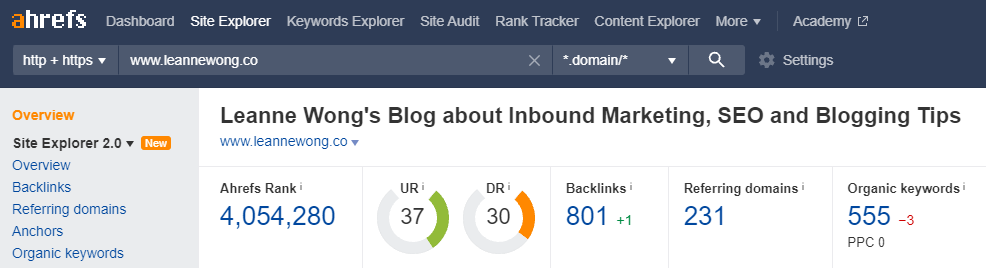
Guest posting
Guest posting is a common link-building tactic to grow your domain authority. The idea is to write a guest article on an authoritative website to contribute content and get a backlink in return.
When I first started blogging in 2018, guest posting was one of the most effective ways to grow my exposure, build relationships with other bloggers and increase SEO authority.
Here’s an example of a guest article I wrote on Miranda’s blog:
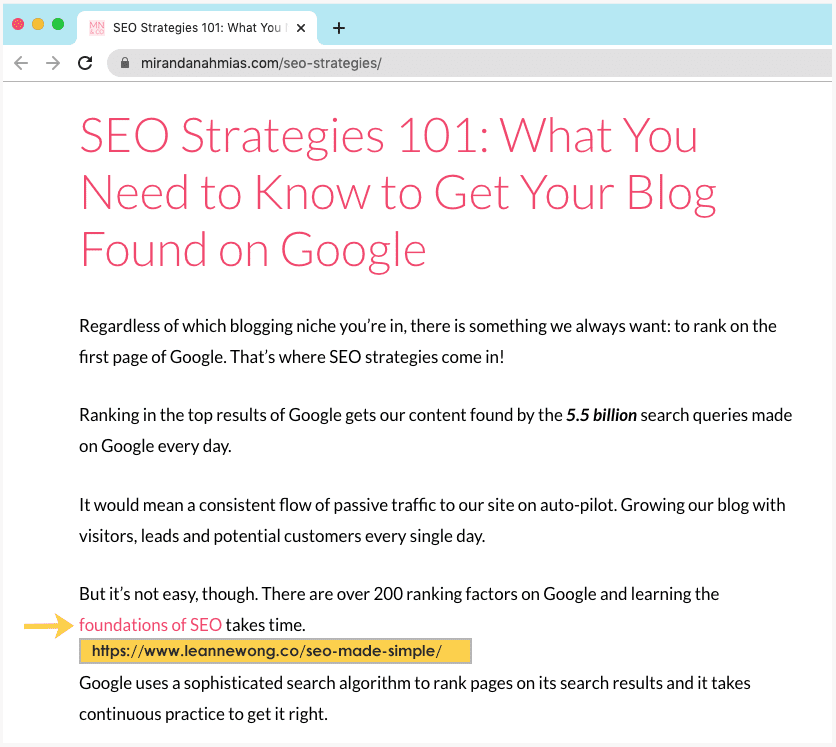
- Miranda’s blog is about business, systems, and marketing, so it was a niche-relevant blog for me to write a guest post. As my specialty is SEO, this adds additional value to her blog content as well.
- The important thing about guest posting as a link-building tactic is the target URL and anchor text. Make sure you select a cornerstone article to link to in your guest post.
- In my case, I linked to my pillar post on SEO Made Simple with a keyword-rich anchor text, foundations of SEO.
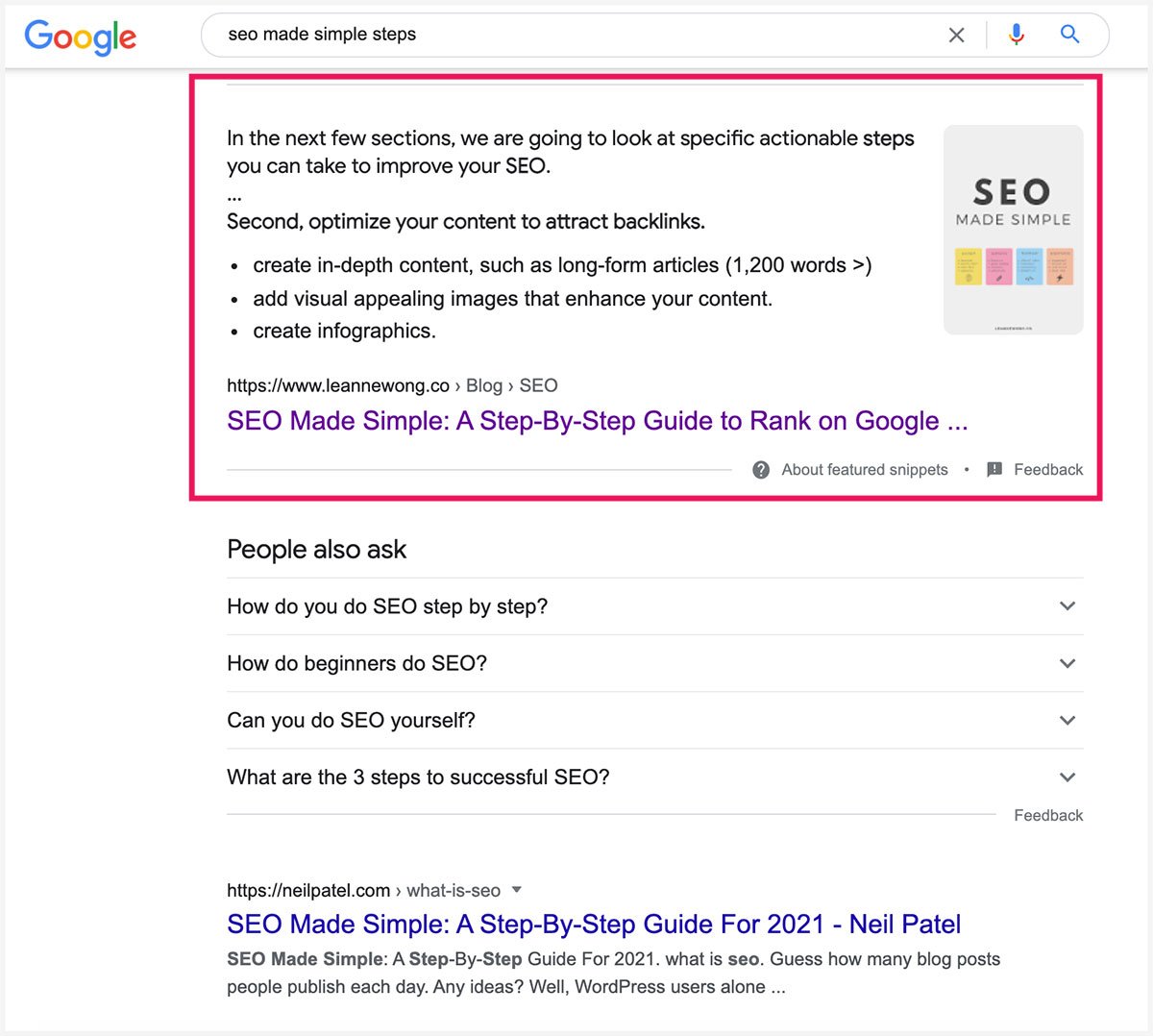
- This boosts the page authority of the article and helps me rank high on Google for relevant search terms. Sometimes it scores a featured snippet too!
Write great content and attract backlinks naturally
While guest posting is a great way to gain more exposure and build backlinks, it is quite resource-intensive.
The best way to grow your domain authority is to simply attract backlinks naturally. Over the years, I have found that case studies and results-driven articles have attracted a number of highly authoritative backlinks to my site.
Mailpoet, Spyfu, Advanced Web Ranking, Brafton are authoritative brands in the marketing niche with a Domain Rating >75.
They have linked to my blog posts and case studies without any manual outreach on my part.
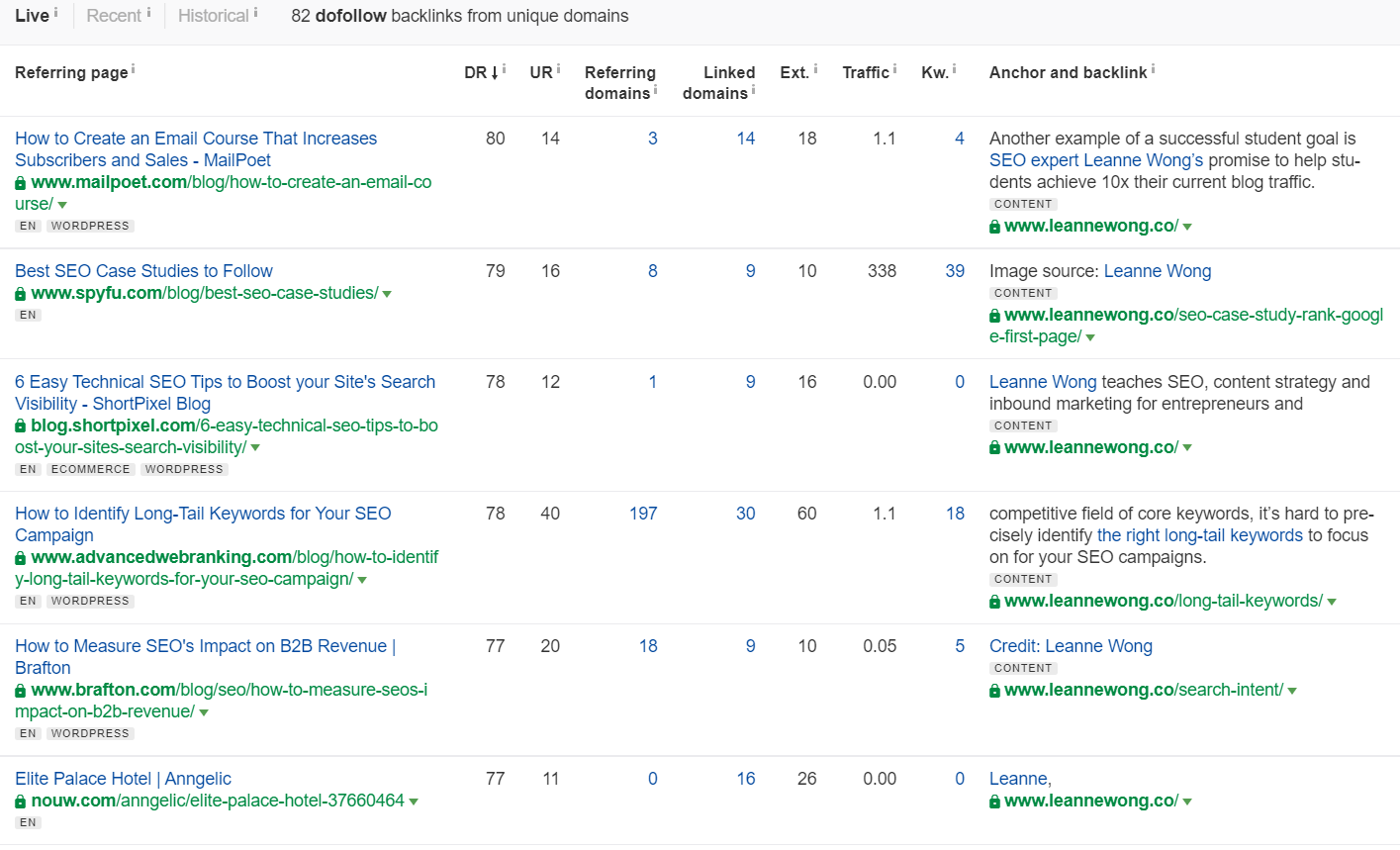 This passes link juice to my entire site and helps with ranking higher on Google, driving more SEO traffic from organic results.
I think natural backlinks are the most scalable to grow your domain authority, and often it simply requires good content for people to link to.





81 people reacted on this
This is a treasure chest of info to increase blog traffic. Bookmarking this so I can finish reading everything. Thanks!
Wow, this is such a good article of SEO 101. Thanks for sharing these helpful info!
This is such a helpful read, especially for non-techies like me. Thank you for sharing your best practices. I will start working on targetting the right keywords for SEO.
I’m learning a lot about SEO these days. What’s frustrating though, is that it’s a constant catch up game – with the frequent changes in the Google search algorithm.
This is interesting, I’m working on improving my SEO a lot these days. And these will help me a lot.
Such helpful information. Definitely bookmarking this page for future reference!
I’ve been trying to dig into my google analytics lately, and this is a big help. Right now my focus on my website is organic traffic so this is so helpful.
I’m really learning so much from these posts. I’ve really been making strides in my SEO, so thank you!
This is incredibly useful information. Organic SEO is so important. You can do all kinds of things to artificially help, but nothing is as good as organic.
I have read through a number of your articles and love how clearly you explain things. Really easy for a novice like me to follow and comprehend. Keep these helpful writings coming please!
Thank you very much for your kind words, Dave! Really appreciate it. 🙂
What an amazing post! I need to work on my SEO I use Yoast but obviously it’s not enough. Thank you so much for this in depth review of the topic I hope the Seo gods will finally be with me ?
XX
Lyna
Haha no problem! Glad you found these tips helpful 🙂
I appreciate you sharing. Most of blog posts are shorter so I’m always trying to get more SEO traffic growth without adding a lengthy post!
Glad you liked the article, Holly! 🙂
Thanks for this, super helpful!
No problem at all, Tiff!
This is such a great insight! I really want to work on improving my SEO!
Cheers!
These are great tips. Such a well written post about SEO. It’s different from other articles I’ve read and I like the content gap idea you share here. Going to spend more time checking out some of the free tools you recommend. Thanks for sharing.
Thank you, Rosemary! So glad that you found the content gap idea useful!
A lot of detailed information packed into this post! SEO is something I’m really trying to work on with my blog, so this is extremely helpful. Thank you for sharing!
Thats awesome, cheers!
Another incredibly valuable SEO article! Content Gap Analysis is something I need to start doing for every post. Thank you so much for sharing your expertise!
Cheers!
Wow, this post is exactly what I needed to read! I just started my blog about 1 year ago and am just now starting to learn about SEO because it was a very slow startup process for me. Very interesting about the SpyFu website. I bookmarked it in case I ever want to go back and take a look. Thanks for all the great information! I feel more confident with SEO now. 🙂
That’s awesome, Traci! So glad to hear these SEO strategies have been helpful for you – keep at it my friend! Let me know if you have any questions along the way 🙂
Great tips, it is such a hard balance to write for SEO purposes vs writing for your readers. I blog for my readers but SEO is so important.
Absolutely, blogging for SEO is really an art and science. Practice makes perfect! Hope these tips have been helpful for you, my dear.
Very useful post. Thank you!
Thank you, Hanka!
This is very comprehensive and detailed explanation regarding SEO for an article. Keep it up the good work! ?
Thank you, Casey!
These are excellent tips – I really appreciate you breaking down the process! Long-tail keywords can be so beneficial for a website and I think that a lot of people forget or don’t know about them.
Totally agree! Long-tail keywords are essential to SEO and can be very impactful for your blog’s traffic growth. Glad you found these tips helpful, Whitney!
These are all great tips! I had never heard of Spyfu before.
Thank you, Holly!
These are great tips! Great job!
Thank you, Christina!
These tips are so helpful, thank you!!!
You’re welcome, Tiffany!
Wow! So much great information. Thank you !!
Cheers!
Bookmarked! Super useful post
Awesome!
SEO is so important! And these are awesome tips! I’m actually currently in an SEO course for my Masters in Digital Marketing and it’s been so helpful and relevant as a blogger haha
That’s fantastic, Keating! So glad this article has been helpful for your Masters. Wishing you the best, my friend. And feel free to let me know if you have any questions along the way 🙂
This was so helpful! I love how you went into details!
Thank you, Amber. Glad you enjoyed the article 🙂
These are really great tips! I’m working on my SEO right now, but it’s such an evolving thing that we have to constantly keep learning about it.
That’s awesome, Angie! Let me know if you have any questions along the way 🙂
Thank you so much for sharing this..I have been blogging 4 years and still have very low traffic because I never have time between writing, social media and working a full time job to dig in and learn SEO..it’s so so hard to master. I am going to go over your post with a fine tooth comb…struggling so bad with it!!
I hope in the near future to hire it out..so if thats something you do , let me know!
Valerie
Hi Val! I totally get you – juggling running a blog and working full time is no easy feat. Kudos to you, my friend! Glad these strategies were helpful for you. I’m launching my flagship SEO course soon, would love for you to hop on the early bird list: https://www.leannewong.co/seo-demystified-course/
Talk soon 🙂
Leanne, this is literally the BEST SEO post I’ve read in a long time. Thank you so much for sharing your valuable SEO knowledge with all of us. It’s greatly appreciated. I learned a lot!
No problem, Denay! Very happy that you found this article helpful. Let me know if you have any questions, my dear 🙂
This is such a great post with so much helpful info! I will definitely be referring to this frequently!
Thank you, Shar. Let me know if you have any questions 🙂
I need to up my SEO strategy as well and this article of yours is going to be a boon.. so thank you.. will check out the tips you have linked as well
Thank you, Vidya.
VERY helpful! I am also pinning this piece, as I know I have a LOT to learn about SEO, and will refer back to this a lot! Thank you!
Glad to help, Mary! Patience is the key to most of SEO and digital marketing. Keep at it and the results will come your way. Good luck with everything, my dear 🙂
This is great information laid out in a clear clean fashion. I am reminded to refocus on my SEO and the tips you have provided are a great foundation. Thanks so much!
Thank you, David. Let me know if you have any questions along the way 🙂
Such good tips! As a new blogger, knowing SEO and how to use it to increase pageviews and traffic to your site is key!
Absolutely! Glad you found these SEO tips helpful, Amanda 🙂
thanks for sharing your knowledge! so much to learn about this subject!
No problem, Laurence!
I only started to get really into my blog and these tips are so useful! Thanks for all the links! A must definitely going to use this 🙂
Hi Maartje! I’m so happy you enjoyed the article, and best of luck with your blog. Let me know your progress 🙂
Wow, this was so packed with helpful info! I’m pinning this to save:) Thank you!
That’s awesome, Marielle! Glad you found the article helpful. Let me know if you have any questions along the way 🙂
This is so helpful! I am going to pin and go back to this when I have time!
Thats awesome, Lauren! Glad you liked it 🙂
This is the most succinct and informative post I have ever come across regarding SEO. I have been struggling with it for awhile now and I am so glad I found your blog. I will definitely put all of this to good use. Thanks so much!
Hi Stephanie, really glad that you found these SEO strategies useful! I try to break it down step by step and as actionable as possible. Patience is the key to a lot of SEO and online marketing. 🙂
Thanks a lot, Leanne, for this detailed and easy-to-comprehend article. SEO is one area my blog is seriously lacking at the moment. This should help.
Hi Seyi! So glad you found these strategies helpful. Let me know your progress with SEO, and feel free to drop me a note if you have any questions along the way!
What a great post! Thanks for the step by step details you provided. This type of detail is perfect for helping me to gain the traffic I’ve been struggling with. Will be saving and using as a continuous source guide! You should also consider making a checklist.
Thanks so much Lauren! Glad you found the strategies helpful 🙂 And yes, definitely – a checklist is in the works. Will drop you a personal note once it’s released. <3
Hey Leanne,
This is such a detailed post. I just found your Blog today on Pinerest, Leanne. And I’m just blown away. I really need to work on my SEO because other than using Yoast, my knowledge is pretty much zero. Thank you for this indepth article. <3
I'm going to read all your other posts now. <3
Warm regards,
Angela
Aww, you’re the best, Angela. Thank you <3