

We’ve heard it – content is king.
Content that is helpful to your audience and builds trust can be a powerful asset to grow a business. This is part of content marketing – providing free educational and valuable content to help your target audience.
In turn, a stranger becomes your follower, customer, and brand evangelist.
Meaningful and effective content attracts quality traffic from search engines and takes your audience through a transformation.
Since starting the LeanneWong.Co blog, blog posts have been the primary way I drive traffic, connect with my audience and build a business. The results have been nothing short of amazing.
A community of 5,600+ people and a digital marketing consultancy serving audiences worldwide with services and digital courses. It all started with a single blog post.
An effective content marketing strategy leverages SEO optimization and content creation. In today’s article, we will learn how to create meaningful content and the SEO strategies to amplify it.
Want to speak to an SEO strategist 1:1 for your blog or business? Check out SEO coaching with Leanne.
Here are the strategies you’ll learn today:
Content List
- Have a clear purpose for each content piece
- Find content topics with long-tail keywords and problem statements
- Find content topics that your audience already cares about
- Create valuable content that builds authority and drives conversions
- Leverage SEO to drive organic traffic and search visibility
- Keyword research and traffic potential
- Optimize for search intent
- Optimize your content for on-page SEO
- Create a link building plan to attract backlinks
- Bonus: Find the best performing content in your niche
- Bonus: Create content buckets for your reader’s journey
Have a clear purpose for each content piece
First, have a clear purpose for every piece of content you publish.
- What is the main takeaway of this content?
- What is the benefit my readers will get?
This can be a quick win that provides immediate relief to a pain point you know your audience cares about.
Think about a ‘Before’ and ‘After’ situation that your audience may be facing.
Though, we need to know what content topic to write about.
Find content topics with long-tail keywords and problem statements
You can find content topic ideas with long-tail keywords and problem statements. Every search query on Google is someone trying to solve a problem.
How your content can directly answer the search query will be key to engaging with that audience.
Your target audience’s ‘before’ position is the current struggle they are facing.
This is where you can build the foundation of your content strategy:
- specific long-tail keywords
- queries of problem statements
A good place to find long-tail keywords is Google’s ‘People also Ask’:

The People also Ask box is where I hang out to find content ideas. I have even created articles targeting a group of related questions found here. It’s still an under-utilized resource and should be in your content marketing arsenal.
Your target audience’s ‘after’ position is the goal of your readers.
It’s why they’ve been scouring the internet for. These are positive outcomes such as:
- happiness / joy / confidence
- solutions and easy fixes to a frustrating problem
Your content then bridges your readers from their current state to a better one.
Find content topics that your audience already cares about
A good way to find content topics to write about is to talk to your audience. Some things I’ve tried:
- Sending a broadcast email to your subscribers asking what topics they would want to learn.
- Use a poll on your Facebook group to ask your audience what topics they are interested in.
- Spy on other Facebook groups in your niche to see what questions people are asking.

These methods are reliable because they are coming from real people with real interests. I already know that there are people interested in these topics and would be receptive if I created new content about them.
Effective content types for blogs:
- Tutorials
- How-to blog posts
- Step-by-step guides
- Practical case studies
- Ultimate guides
I find that tutorials and how-to blog posts are easy wins because they are easy to create and immediately solve a pain point.
They could be between 800 – 1000 words. Target a focus keyword and serve one objective.
Case studies and ultimate guides are my favorite. They are also called cornerstone content or pillar pages.
Because they are so meaty and lengthy (3,000 words or more), they rank for a lot of keywords and long-tail traffic. These articles tend to have a good ranking ability because of dense topical targeting.
Create valuable content that builds authority and drives conversions
Effective content marketing converts into business value.
So we have to make every piece of content we publish count. I prefer quality over quantity.
It takes a few days for me to publish an article and sometimes a week to write a lengthy guide. Content marketing pays off when your audience becomes your customer.
This is the surest way to assess the ROI of content.


By publishing in-depth guides and content on the blog, I get a steady stream of new client inquiries organically. No cold calls or outreach. People come to you naturally – create content that drives your business bottom line.
Content is also a great way to grow your email list and subscriber count.
Leverage SEO to drive organic traffic and search visibility
Content creation needs to be optimized for SEO to be discovered by search engines and rank on the first page. You want your hard work to be driving traffic from Google.
Leveraging SEO means creating content with SEO in mind.
The shift to mobile-first indexing, and most recently in 2021 the page experience (Core Web Vitals) update, have increased the complexity of SEO.
Not only do we have to create valuable content, but we have to also optimize for mobile, site speed, and page experience.
That means image optimization, converting our images to Next-Gen format, compression, optimize CSS and Javascript.
As Google’s search engine algorithms evolve constantly, we have to keep abreast of what’s currently working and what’s not. These can change every 6 months and major changes can happen every year.
Emphasis on E-A-T (Expertise, Authority, Trust) and content quality
Google knows what is high-quality content better than us. Following the E-A-T principles provides a sense of what quality really entails.
Then, update your content regularly. Ensure that you have fresh content and that it is inherently useful.
Also, Google has shifted to more sophisticated systems with natural language processing, machine learning, and artificial intelligence.
RankBrain, Hummingbird, and BERT updates have placed greater emphasis on understanding search intent and semantic context.
Instead of mining for individual keywords, you want to look for topics and a pattern of words and phrases that have contextual relevance. This is where keyword research comes in.
Keyword research and traffic potential
Keyword research remains the bread and butter of SEO. Understanding what kind of search terms your audience uses is the start of creating content that people are looking for.
Then, we want to look into search traffic potential. How much traffic you could potentially drive to your website by ranking your content on Google.
Keywords with high traffic potential have high search volume. You can easily gauge the search volume of a keyword with tools like Moz, Ahrefs, SEMrush, Ubersuggest, and Google Keyword Planner.
We are looking for the average monthly search volume of a keyword.
Screenshot from Google Keyword Planner:

I trust Google Keyword Planner over other tools because it comes directly from the source itself – Google.
Only Google knows how many searches are made on its search engine. Checking the search volume of keywords is important because you want to rank for keywords that can bring you traffic.
A general rule of thumb is to aim for keywords with at least 1K-10K avg. monthly search volume.
Optimize for search intent
Search Intent is the purpose behind a person’s search.
Somebody searching for “cheap coffee machines” is likely looking to take action to make a purchase.
You’ll notice Shopping Ads on the search results –

You might also see Local Maps on the search results –

This indicates that the intent for “cheap coffee machines” is transactional in nature. Google is giving us valuable hints on its search engine results page (SERPs) already:
- Shopping Ads
- Local Maps
- Google My Business Listings
- Google Ads
Search intent is key to creating the right content type to rank on Google.
If we want to rank for “cheap coffee machines”, informational content like blog posts would NOT satisfy this purchase intent and that’s why blog posts are not dominating search results for this keyword.
The right content type would be product pages. In this case, a cafe or commercial website where people can actually purchase a coffee machine. That’s why we see Google ranking e-commerce websites and coffee brands ranking high on SERPs.
Creating the right content that is aligned with search intent is as crucial as that content ever ranking on search results at all.
Read more: What is Search Intent in SEO? A Guide to Writing Content that People Love
Optimize your content for on-page SEO
After keyword strategy and search intent, optimize for on-page SEO.
Optimizing your blog post is more than just adding keywords to your article.
- What part of my article has the most impact on rankings?
- How can I improve the SEO-friendliness of my article?
- How can I create SEO-optimized articles that have the best chance possible to rank on search results?
On-Page SEO is all about making optimizations on the page to improve search engine rankings. These are factors such as title tag optimization, headings, and internal links.
How to optimize for on-page SEO
- Keyword targeted in the title, meta description, and URL.
- Content should be sufficient and target a variety of long-tails and keyword variants.
- Images have alt text and contain relevant keywords.
- Internal and external links are on the page, with keyword-optimized anchor text.
- Compress your images and ensure that each image size is not more than 200KB, the smaller the better as it reduces the time needed to load your page.
- Use Google Analytics to check the bounce rate of your website and key pages.
- Check the page speed of your website and blog posts. Ideally, it should load in under 3 seconds.
Read more: 7 Elements of a Perfectly SEO Optimized Blog Post (+Checklist)
Create a link building plan to attract backlinks
Highly quality backlinks are important to boost keyword rankings and traffic from Google. Content needs links to rank.
But link building is often a resource-intensive and potentially expensive task.
A better way?
Write good content that gets backlinks and press mentions naturally. I’ve found that extremely useful and results-driven case studies are the most effective at attracting backlinks.
I use SEMrush to assess the authority of backlinks. High-quality backlinks come from websites with an authority score of 50 or higher.
Backlink from Spyfu.com
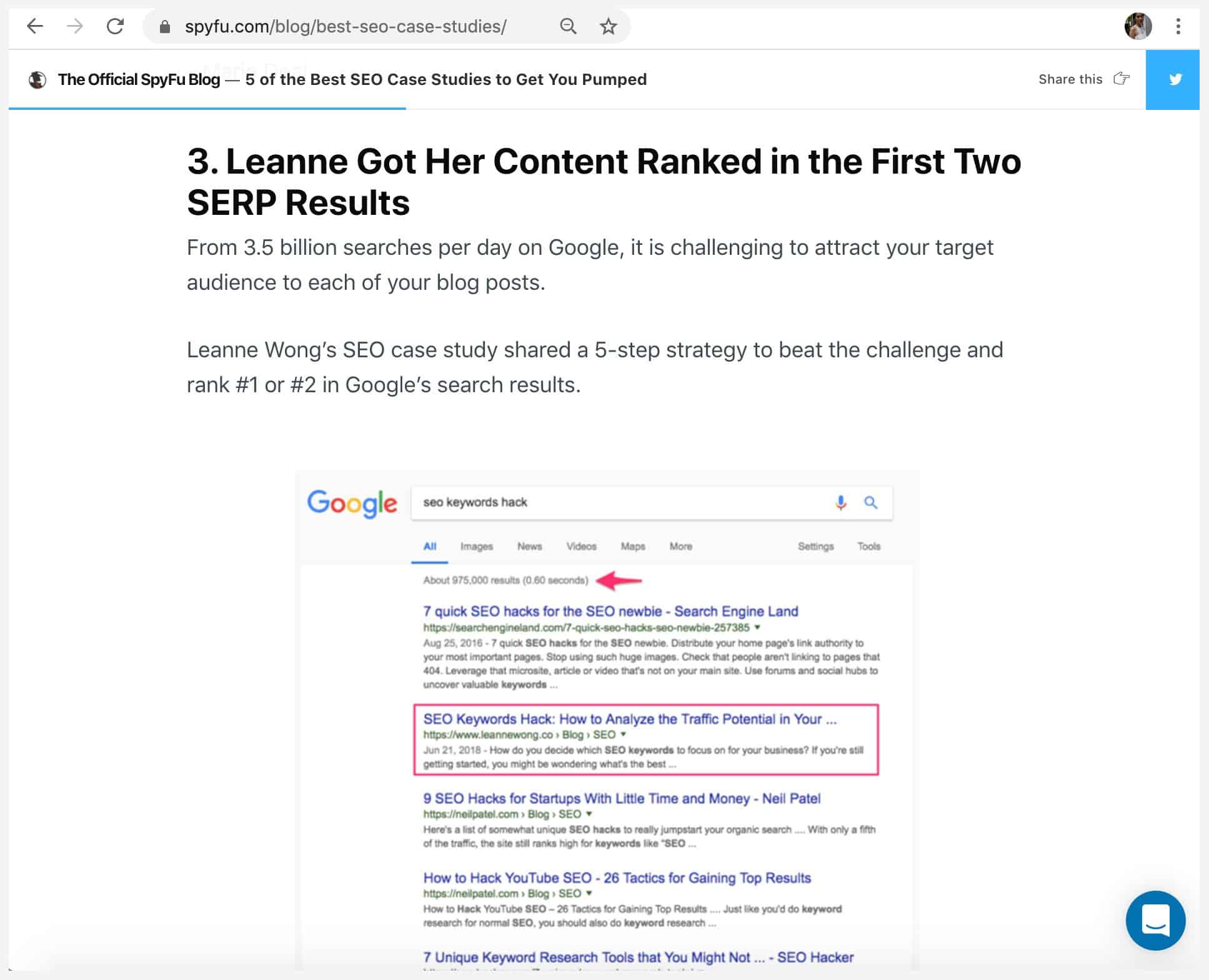
Spyfu.com is an authoritative company in the SEO industry with a pretty high authority score (64/100). I was quite happy to get featured in their blog because not only did it provide a high quality backlink to my website, but qualified referral traffic too.

In Spyfu’s article on ‘5 of the Best SEO Case Studies to Get You Pumped’, they featured my SEO case study:
Backlink from Nichehacks.com

Nichehacks.com is an authoritative blog about digital marketing and affiliate marketing. In their article, they showcased my case study about Pinterest Traffic:

Backlink from Mailpoet

More recently, an article from Mailpoet featured my email course:

There was no manual outreach done to get my articles featured on these authoritative websites at all. I noticed these new backlinks from the backlink alerts from Ahrefs.
I believe my articles were found on Google and Pinterest, and then picked up as a case study. That’s the power of content marketing, it has legs way beyond its publication date.
Improve page authority of your content to boost rankings
Link building is an essential part of SEO.
We need backlinks to rank on Google. Don’t just build backlinks to your homepage though, because you want to distribute link value from backlinks throughout your website.
Most importantly, you want to improve the page authority of key content pages on your website.
- Domain authority = overall authority of your entire root domain (website)
- Page authority = individual authority of a single page (URL)
Different pages on your website will have different page authority. The most common case is that your homepage has the highest page authority because it attracts the most number of backlinks.
Part of your link-building strategy should be to build authoritative backlinks to individual, specific pages on your website. Such as:
- Pillar pages
- Cornerstone blog posts
- Evergreen product / service pages
- Opt-in landing pages
Higher page authority increases the trustworthiness of that page and thus, increases its ability to rank higher on Google.
Bonus: Find the best performing content in your niche
A smart way to create content is to replicate what already works. We can easily find the best performing content in any niche by using tools like Buzzsumo, Ahrefs, SEMrush, and Google Keyword Planner.
No need to start from scratch. Find a well performing article and replicate the same success.
Buzzsumo
Buzzsumo: the best free tool to find the most shared content.
- Type in your topic and use a handy tool like Linkclump to copy all the URLs from those articles into a spreadsheet.
- These articles have proven to work and should have a similar success pattern. Dissect their structure and create content that further adds to the conversation.
- Take note of the title, meta description and sub-headings.
Ahrefs
Ahrefs Content Explorer: a premium tool by Ahrefs to discover the most popular content in any topic, by organic traffic, backlinks and social shares.
- It’s practically an all-in-one suite for content research. You can try signing up for their 7 day trial for $7 just to see the comprehensive results for your research.
Google Keyword Planner
You can also use Google Keyword Planner to find keywords that a page is ranking for.
Here’s an example to create epic content using Google Keyword Planner.
Create content buckets for your reader’s journey
Your blog is a network of content pieces in a niche that targets a specific audience.
Content buckets help you organize your content pieces to get your readers from one point to another. It’s a journey you craft for your audience.
No one can become an expert in a particular topic after reading 1 article.
You need different types of content mapped to different search intents. A person visiting your site for more information might be looking for a resource article or tutorial post, whereas someone searching for a solution is more ready to convert into a lead.
Having content buckets enables your blog to act as a sales funnel that turns visitors into leads and into paying customers.
But your reader gets there step by step. Through multiple blog posts and content formats, at different touchpoints with your blog.
Some examples of content buckets:
- Awareness: to attract visitors and cold traffic
- ‘How to’ articles
- List posts
- Guides
- Roundup articles
- Consideration: to attract leads
- Case studies
- Tutorials
- Free resources
- Purchase: to convert into sales
- Webinar
- Free trial
- Demo
Content strategy needs to support your business goals
Ultimately, content is a vehicle to drive your business forward.
Publishing content on an editorial queue without SEO in mind does a disservice to its potential. Make sure to learn about SEO and work on both content creation and SEO in tandem.
Have you tried any of the strategies here? Let me know in the comments below!





65 people reacted on this
I love these.. They are really useful.. I always love to make How To articles as they are not just informative but also fun to write.. However, i can’t create much of that kind of article for my niche which is travel.. Although i agree that once you find a content that drives more traffic, you can create more of those to effectively expand your audience or readership.. Thank you for another amazing seo tips
Oh hmm i feel that travel could be quite an extensive topic!
Hhhhhmmmm…I have to start making use of Google Keyword Planner more. I always think I can wing it on my own but the end result is never the way I want it. Thanks for the tip, Leanne!
Great tips and strategies! I can definitely use some of it for my website. I will follow it.
Awesome tips, we need to improve our content marketing. This also makes it fun.
I learned a great deal from reading this blog post! Thanks so much for sharing all of this valuable information on marketing. 🙂
Cheers! So happy to hear this!
On “people always ask “is fantastic. I always find it interesting to look at that but I never really knew for sure that it would be a good way to build.
It’s a good place to look for content topics!
amazing tips! people really need to put more effort into SEO
Cheers
Planning plays an important role too in publishing content. You gotta plan your content, search for keywords and make sure it aligns with your business goals. I really find your guide helpful. Thank you for sharing
Cheers! Thanks Beth.
Having a clear purpose for each content you put out there is important. When I started blogging I would publish any topic I am interested in writing, but now I make sure I have a purpose, either it’s for my affiliates or to answer what people are searching on the internet.
That’s a solid strategy!
My husband and I just went through our business goals for the remainder of this year and next year. One of those is to really improve my backlinks so I’ll be working on that soon and I’ll follow your tips.
Backlinks are important for sure. All the best, Stephanie!
I’m working on SEO this month and it’s so overwhelming. Thank you for putting this into terms I can understand.
Happy to help, Heather!
Great tips I love you point about creating a clear purpose for each content piece. I always like to reverse engineer my posts around people’s pain points.
Thank you! Yes that usually targets a certain intent quickly 🙂
Thank you so much, I definitely need this! I just got my blog to the point where I consider it ready for people to see–but I have no idea what to do next! There’s so much to learn about blogging and I appreciate how you’ve broken it down so there’s a roadmap to follow.
I’m sooo happy to hear this! Cheers 🙂
SEO is so intimidating to me, I find myself trying to learn all I can from it. However, there is just SO much information about this topic. You’re ties are truly helpful!
SEO is not easy at all! Take your time 🙂
Wow, another thing I’m bookmarking because this is so helpful! I totally believe that content needs to help someone. Will be digging into this more later!
Cheers!
Such a great in-depth blog post. I always tell people just starting out to make helping people and answering their questions your main priority!
That’s sound advice, indeed!
Another well researched and wonderfully written article Leanne! Your knowledge and fluency with this subject shine through without being intimidating or overpowering. Well done and extremely helpful for new bloggers like myself. Thanks
Thanks so much, Dave!
Great Article, Leanne. The best thing is that I found it at the right time, when I am planning content for my new blog. Thanks.
That’s awesome, Hina! Glad you found this blogging guide helpful!
Such a great article, thank you for sharing these tips and helpful tools to use to grow as a content creator. I’ve actually stumbled on this post before and am happy with my growth!
Cheers!
Leanne, this is such awesome SEO advice! Right now my goal for 2019 is to work on SEO: refurbishing old content and reposting, and creating new content that is SEO strong! Thank you so much for breaking down the strategy into small bite-size pieces that are easy to understand.
I’m so happy to hear that, Denay! That’s awesome.
What a fantastic post! Will definitely be pinning this for later & will implement some of your tips as I plan out my content for the next few months! Thanks for sharing!
-Madi xo | http://www.everydaywithmadirae.com
Woohoo!!!
Your posts are always so solid and full of GREAT advice! I have so many of them bookmarked. This one is super helpful, thank you!
Awwww thank you so much, Sam! Glad you’re enjoying the blog 🙂
The advice in this blog post was absolutely phenomenal! I actually spent time jotting down major takeaways and notes in a notebook, which I rarely do! But you made content marketing so easy to understand. Thank you so much for writing this valuable piece of content!!
Thank you so much for your kind words, Juliet! Means a lot. Glad you found this massive guide (probably my most comprehensive guide on blogging) useful!
Thanks for all the wonderful tips in creating great content. I’m always looking for ways to improve my production.
You’re welcome, Dianna! Cheers.
Such great advice. I’ve bookmarked your page.
Cheers!
Some great information and tips here. I have taken a notes. Thanks for sharing.
Awesome, Charlotte. Let me know if you have any questions along the way 🙂
Wow, I love the level of detail and the specific examples! So many posts on this topic say “create great content,” but you break down what that actually means. I also like your tips about targeting reader’s pain points and understanding your reader on an intimate level. There’s one person I follow who makes YouTube videos and it’s amazing because I always feel like his videos are reading my mind!
Thank you, Kate! Soooo happy you enjoyed the article (took me almost 2 weeks to write this massive piece), but it’s so worth it 🙂 Let me know if you have any questions along the way, would love to hear how the strategies have worked for you.
Wow I am still so lost on SEO after 4 years of blogging..it is so so much to understand and study…It seems by the time you write, take photos, edit, promote , site maintenance etc…there is hardly time to dive into this stuff…I know this is why my page views still suck after 4 years- even though my content is good… I need to spend some time on your site!
Thank you for sharing!
Hi Valerie! I feel you, SEO is not an easy topic to grasp – so many components and technicalities make it incredibly overwhelming.
This is great advice, especially for me who is running a blog and want to increase traffic. Thanks for sharing!
So glad to hear that, Olle! Please keep me updated on your results, would love to hear how the strategies have worked for you 🙂
Love that you took the time to write this. I am looking forward to taking what you wrote and putting into action!
Woohoo! That’s awesome, Kara! Do keep me updated on your results please!
Wow! So many helpful tips, and I love how you laid it all out.
Thank you, Brandi! Glad you found the article helpful!
Hello there.
Good to read. In my own opinion, guest post on sites like HBR, Killer Startups or Blogr can bring lots of benefits to your name as an author and boost up your online presence.
Kindest Regards: Chris
Totally agree!
Excellent share. Creating content bucket and writing content for each bucket is a super helpful strategy that works. Thanks for sharing it 🙂
YAY! I’m so glad you liked the post, Shafi! Thanks for reading 🙂
Some great info here! Thanks for sharing!
I’m so glad my blog posts have been helpful for you, Emily!